

Georgia’s position as the economic engine of the American South makes its transportation network one of the most intensely utilized grids in the country.
Anchored by the sprawling hub of metropolitan Atlanta, the state acts as a massive logistics bottleneck where cross-country freight lines collide with dense, multi-lane suburban commuter routes.
While the state’s well-maintained highway system keeps commerce moving, the sheer density of vehicles and elevated travel speeds make certain corridors hotbeds for catastrophic accidents.
Navigating the rapid lane shifts and unpredictable traffic spikes across the state demands sharp defensive driving. It also highlights why keeping a reliable roadside assistance program on standby is a critical precaution for anyone regularly traversing Georgia’s pavement.
When examining data from the National Highway Traffic Safety Administration (NHTSA) and the Georgia Department of Transportation (GDOT), several specific highways emerge as exceptionally dangerous due to high crash volumes and elevated fatality rates per mile.
1. Interstate 285 (I-285): “The Perimeter”
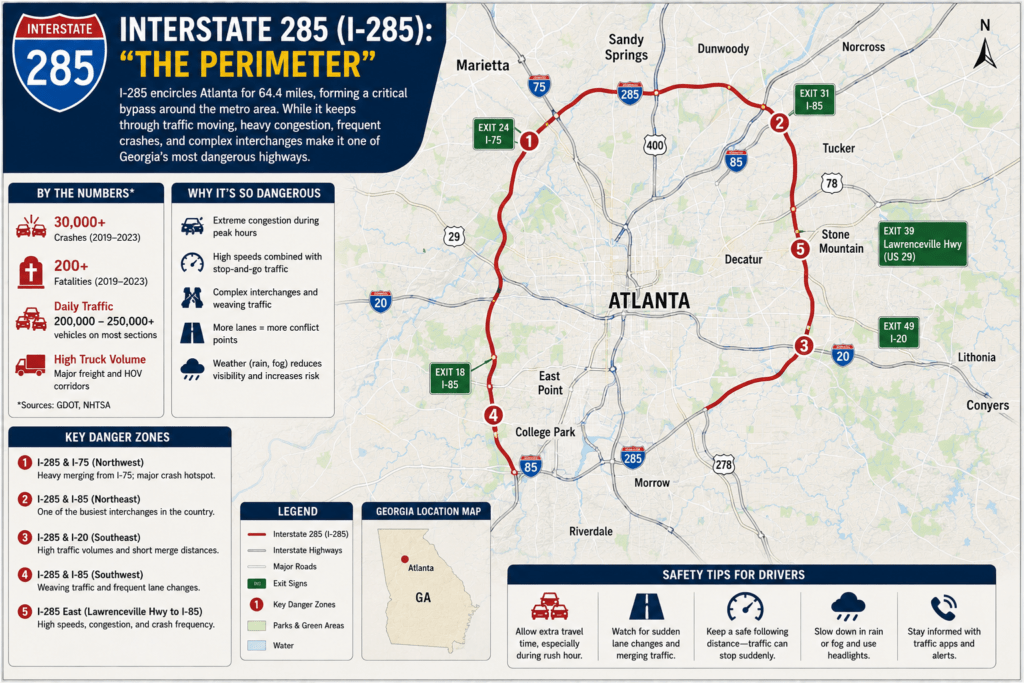
Encircling the city of Atlanta in a 64-mile loop, Interstate 285 is colloquially known by locals as “The Perimeter.” It handles upwards of two million vehicles daily and has historically been ranked by federal traffic data as one of the single deadliest interstate loops in the United States.
- The Freight Bottleneck: Because long-haul commercial trucks are restricted from driving straight through downtown Atlanta via the I-75/I-85 Downtown Connector, they are forced onto I-285. This results in an incredibly tense environment where heavy 18-wheelers constantly mix with fast-moving passenger vehicles.
- The Southside Hotspots: Multi-year crash analyses reveal that the southern and eastern arcs of the loop, specifically the stretch running through DeKalb and Clayton counties between the Route 6 interchange and Riverdale Road, experience an intensely high concentration of fatal lane-weaving collisions.
2. Interstate 20 (I-20): The East-West Hazard
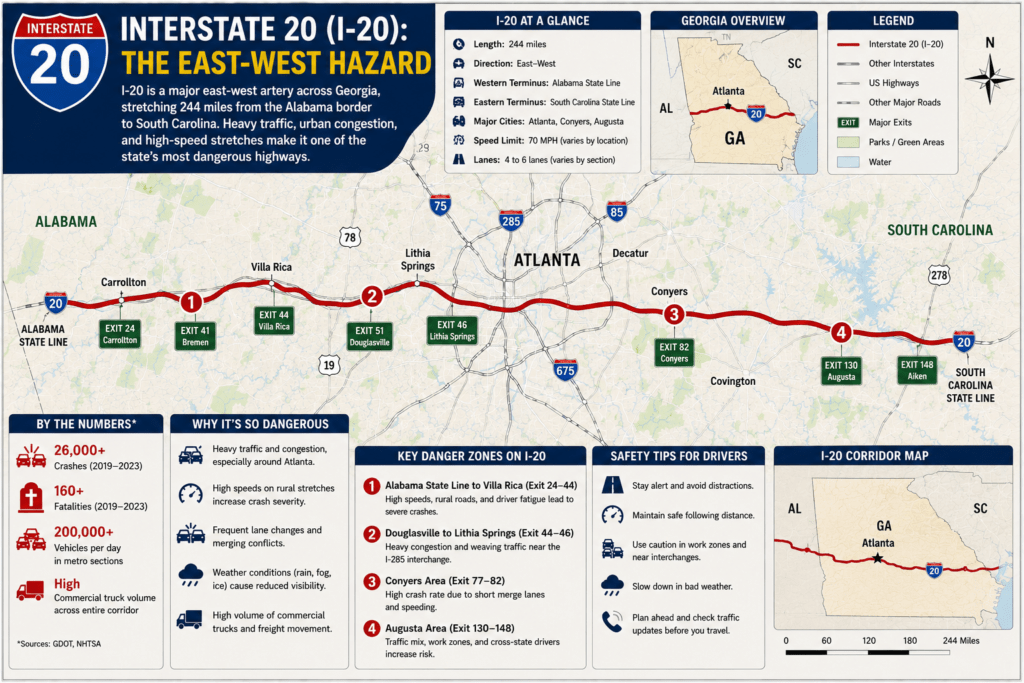
Interstate 20 crosses the width of Georgia, entering from Alabama, piercing straight through the center of Atlanta, and exiting into South Carolina near Augusta.
Federal safety assessments have previously flagged segments of Georgia’s I-20 corridor as some of the most dangerous asphalt in the country.
- The DeKalb County Cluster: The 5-mile stretch of I-20 running through DeKalb County (particularly between Exit 71 at Lithonia Industrial Boulevard and Exit 65 at Columbia Drive) is notoriously hazardous. This sector suffers from sudden stop-and-go bottlenecks that cause severe high-speed rear-end pileups.
- Speed and Terrain: Outside of the metro core, high legal speed limits paired with rolling terrain create blind crests where drivers frequently fail to react in time to stalled vehicles or sudden slowdowns ahead.
3. Interstate 75 (I-75): The 339-Mile Transit Spine
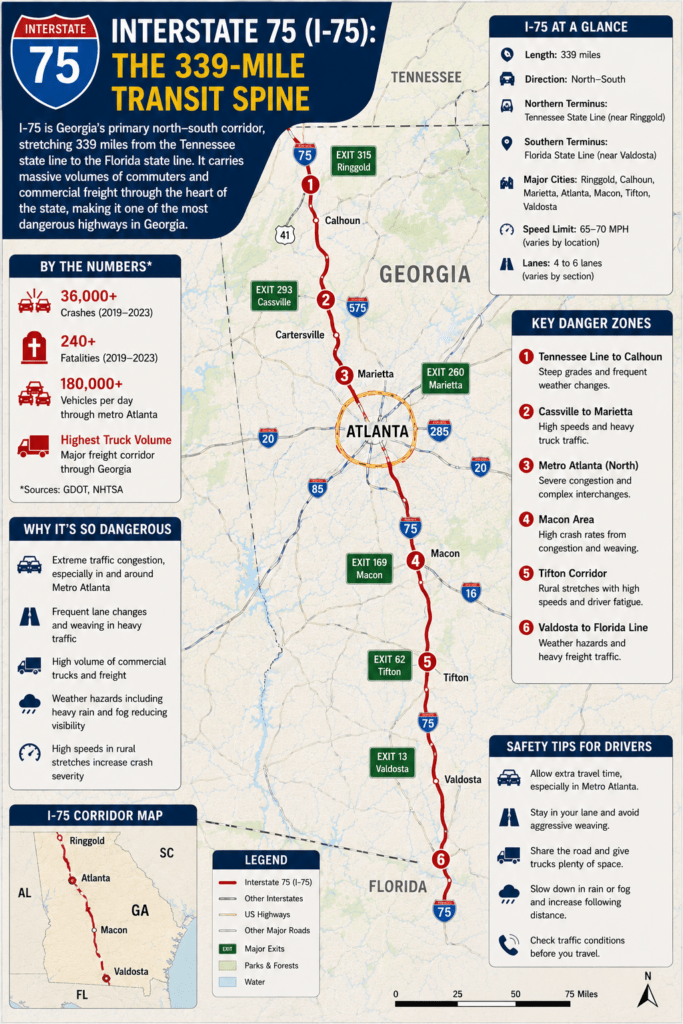
Running from the Florida border all the way up through Valdosta, Macon, Atlanta, and Chattanooga, I-75 is the longest interstate corridor in Georgia. Because of its massive geographical footprint, it logs one of the highest total numbers of raw accident fatalities in the state.
- The Tourist-Freight Mix: I-75 serves as a primary pipeline for midwestern tourists driving south to Florida, creating an unstable mix of heavily loaded, slow-stopping freight trucks and distracted, long-distance vacationers prone to road fatigue.
- The Cobb County Surge: The northern suburban segments running through Kennesaw and Marietta experience intense commuter friction, where rapid merging patterns and narrow shoulders leave almost zero room for driver error during rush hour.
Statistical Snapshot: Georgia’s Deadliest Driving Zones
Recent tracking from NHTSA’s Fatal Accident Reporting System (FARS) reveals that while interstates carry the most traffic, state routes and local arterials often register higher fatal crash densities per mile.
| Highway Corridor | High-Risk Geographic Focus | Primary Drivers of Fatalities |
| I-285 | DeKalb & Clayton Counties | Truck/passenger car friction, complex interchange merges |
| I-20 | Atlanta & Decatur Segments | Speeding, aggressive tailgating, severe urban congestion |
| Moreland Ave (SR-42) | East Atlanta Suburbs | High pedestrian density, multiple traffic signals, sudden braking |
| I-85 | Downtown Connector & Gwinnett County | Dense multi-lane configurations, extreme rush-hour gridlock |
| State Route 316 | Gwinnett to Athens Corridor | Heavy college commuter traffic, intersection conflicts |
4. Moreland Avenue (State Route 42): The Deadliest Arterial
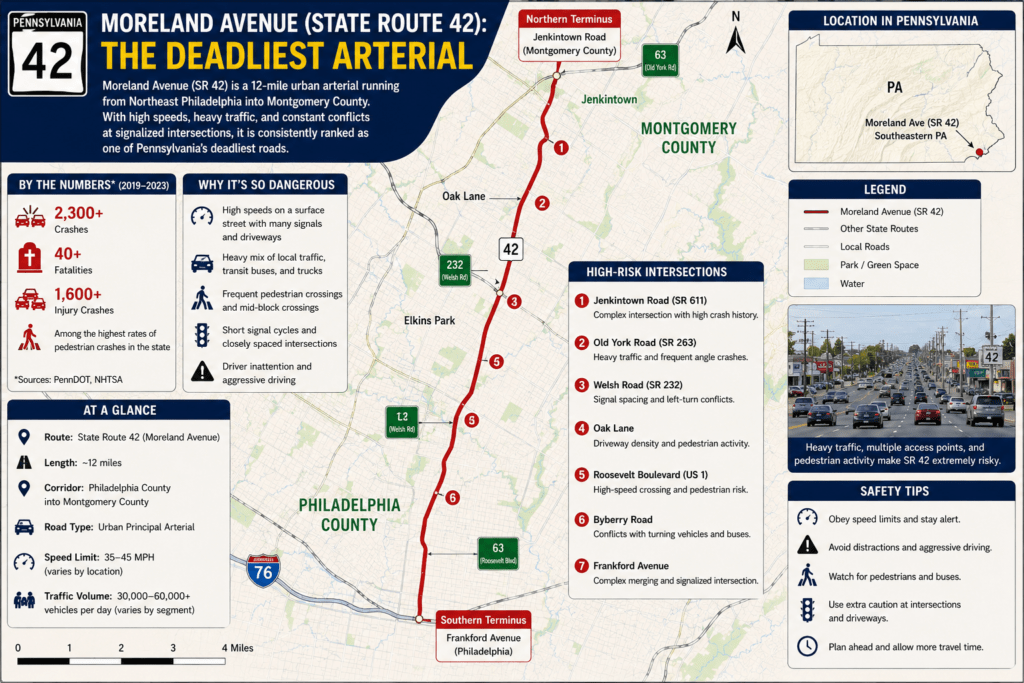
While interstates dominate the headlines, a specific 5-mile stretch of Moreland Avenue running through East Atlanta suburbs consistently ranks as the single deadliest surface road stretch in the state by density.
Unlike an interstate with controlled access ramps, Moreland Avenue is a high-volume commercial corridor packed with retail driveways, cross-streets, and a high density of local foot traffic. Because vehicles travel at highway speeds between closely spaced traffic lights, it experiences an alarming rate of T-bone collisions, pedestrian strikes, and high-impact left-turn accidents.
5. Georgia State Route 316: The University Parkway
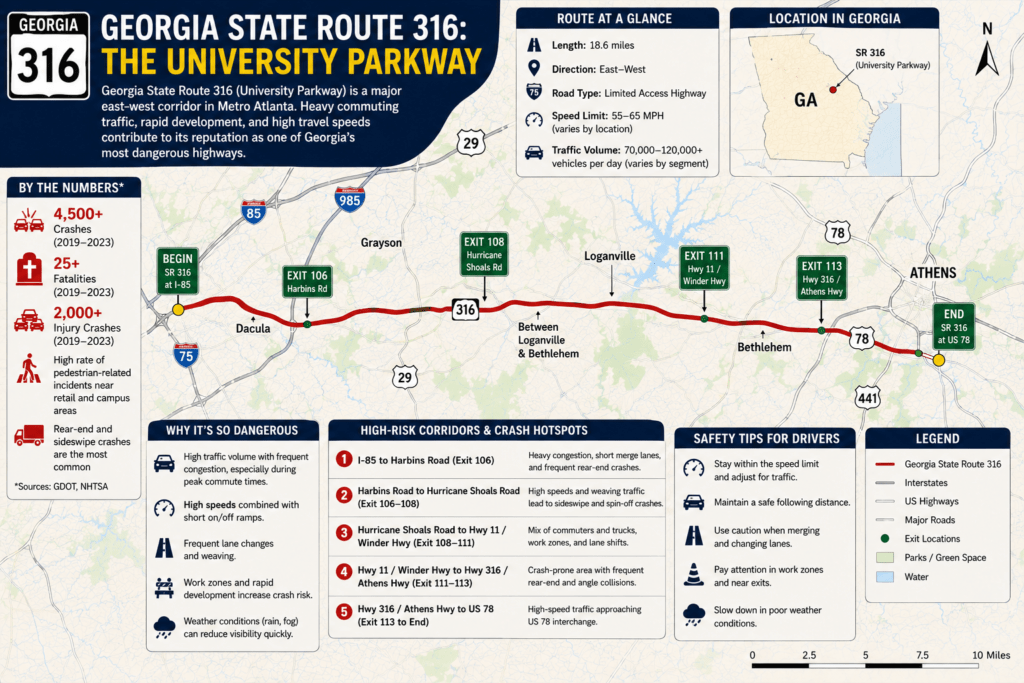
Connecting metropolitan Atlanta directly to the university hub of Athens, SR-316 (University Parkway) is a roughly 40-mile highway notorious for its volatile safety record, with crash rates traditionally resting well above the state average.
Stay Safe on Georgia’s Roads
Whether you’re dealing with a flat tire, a vehicle breakdown, or need emergency towing on Georgia’s busiest highways, DriveSafe Solutions is here to help.
Our towing services, Tire Repair Services, and Mobile Mechanic Services are just a call away. Contact us anytime at +1 (866) 890-7355 for fast, reliable roadside assistance and get back on the road with confidence.